


Let's Talk
We'd love to hear about your project. Book a time that works for you and we'll take care of the rest.
- Commercial projects
- Education & institutions
- Partnerships & resellers
- General inquiries
We'd love to hear about your project. Book a time that works for you and we'll take care of the rest.
Contents
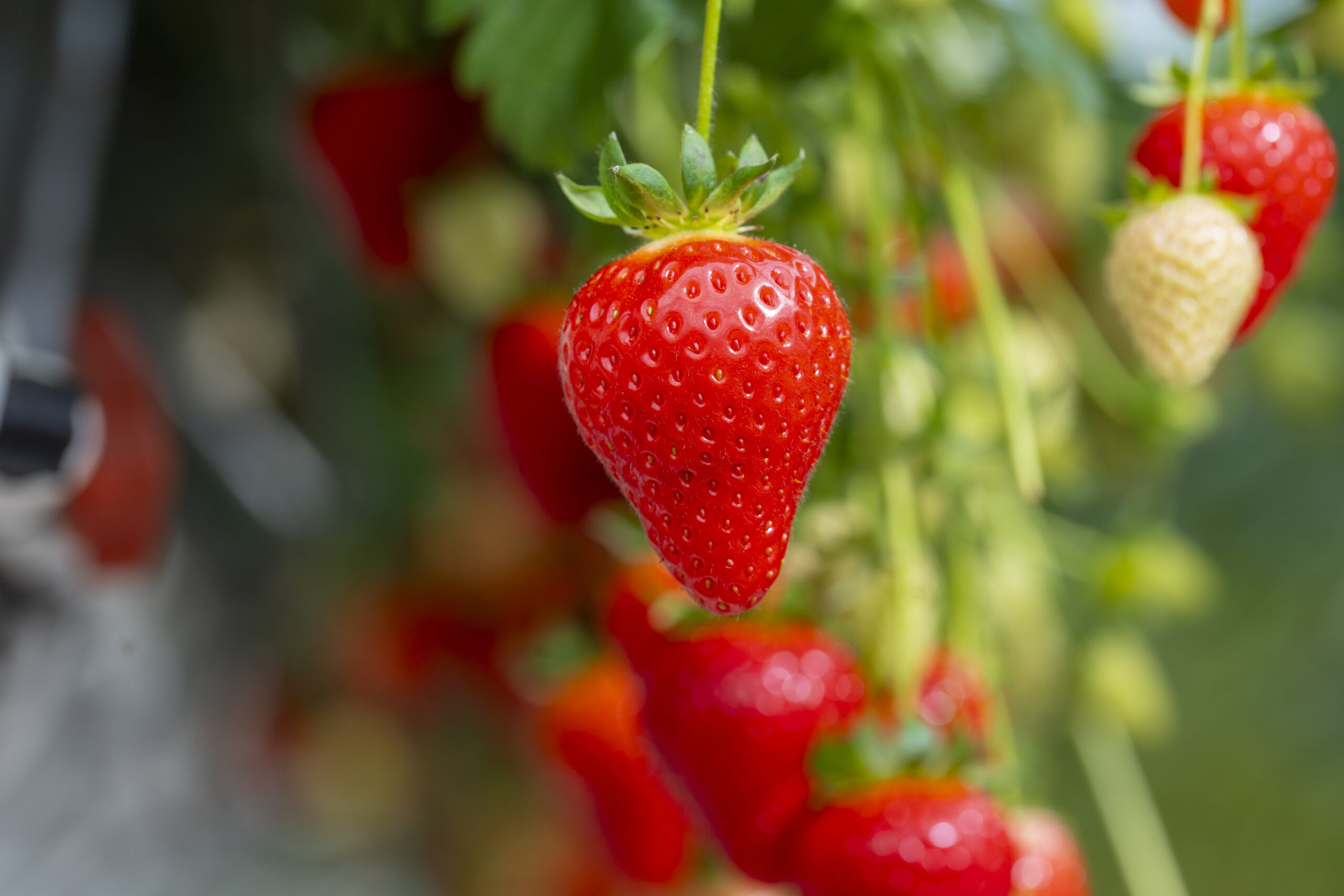
Imagine a giant Ferris wheel, but instead of carrying people, it carries a million strawberry plants slowly toward the sun. That is exactly what Dyson Farming has built at its Carrington site in Lincolnshire, and it is a major milestone for the future of vertical farming.
When a global brand famous for precision engineering invests heavily in controlled environment agriculture, the entire industry gains a massive boost in credibility. Dyson’s high-tech glasshouse currently spans 26 acres and is expanding to 42 acres by mid-2026, relying on a unique rotating method the company calls the Hybrid Vertical Growing System, or HVGS.
Essentially, Dyson has proven that vertical farming can succeed at an industrial scale when you pair the right crop with the right design. At the same time, this industrial-scale approach is just one of many successful models in our industry. While it excels at high-volume, single-crop wholesale production, they operate alongside modular indoor farming setups designed for an entirely different purpose. For schools, universities, and local community hubs, the goal is not to manage acres of glasshouses, but to grow a diverse variety of fresh produce reliably right inside their existing facilities, regardless of the climate outside. Together, these two distinct approaches show the versatility of vertical farming, proving that the technology can serve both national supply chains and local neighborhoods.
The significance of Dyson's expansion lies in the rigorous engineering discipline they bring to the table. Between 2022 and 2025, the vertical farming sector absorbed a string of high-profile bankruptcies, and several well-funded companies that had set out to reinvent urban food production closed their doors instead. As a result, industry observers began to ask harder questions about whether the underlying economics could work at scale, even as the technology itself continued to mature.
Dyson's decision to expand its Carrington site offers a compelling answer to those questions. Dyson built its reputation through precise mechanical engineering, and the company has a long history of entering categories only once the engineering case is proven. Consequently, when that same discipline turns toward strawberries, it becomes a signal to industry analysts that indoor farming is transitioning from a speculative tech trend into a highly stable, commercially viable sector. For anyone sourcing local food at scale, this move shows that high-tech agriculture has moved past its experimental phase and is ready to deliver consistent, year-round volume.
Source: Dyson Farming
For organizations evaluating the potential of indoor agriculture, this development is an encouraging milestone. It demonstrates that when agricultural technology is backed by rigorous planning and solid engineering, it can support large-scale, sustainable food production and offer predictable, year-round supply chains for major retailers.
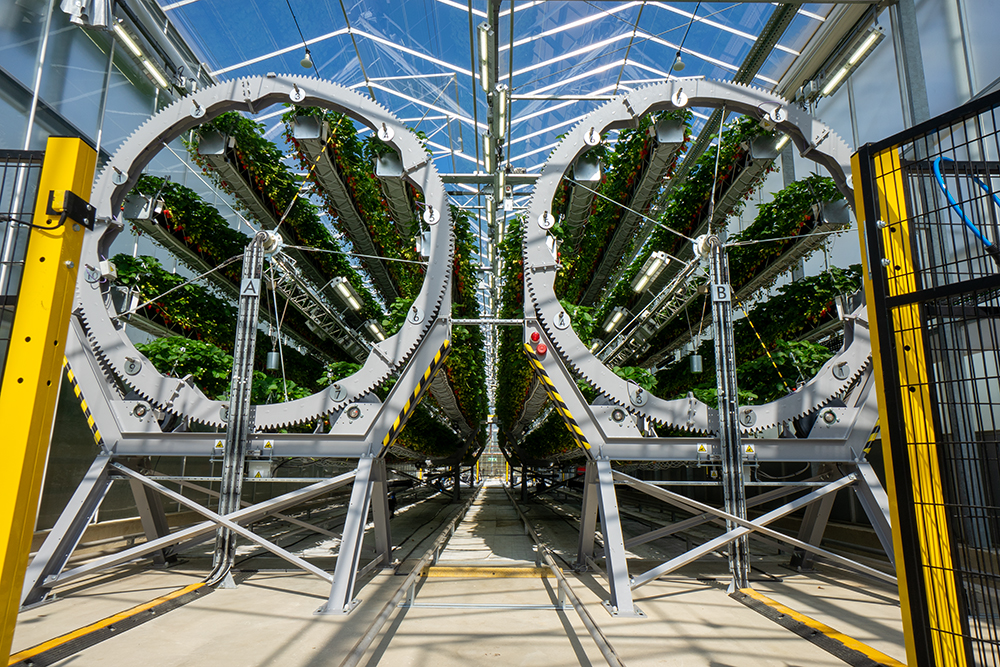
The High-Density Vertical Growth System (HVGS) is a mechanical rig designed to continuously rotate crops through a glasshouse environment, ensuring optimal and uniform light exposure for every plant. While traditional vertical farming maximizes space by stacking trays on fixed shelves, a method that requires precise engineering to avoid light variance between tiers, the HVGS approach introduces dynamic movement to the equation. By constantly cycling strawberry plants through the best available light, Dyson's system gracefully resolves the microclimate challenges of static shelving, offering an elegant alternative that balances high-density cultivation with consistent, natural light integration.
Source: Dyson Farming
According to data released by Dyson Farming, the facility’s rotating rigs stand roughly 5.5 meters tall and hold close to 1.2 million plants across the site. The company reports that this slow, continuous rotation delivers 2.5 times the space efficiency of standard vertical farms that stack rows under LED lights, while also creating a 250% yield increase compared to standard glasshouse growing.
This massive jump in production completely changes the game for supermarkets and shoppers. Because these rigs can churn out massive amounts of berries year-round regardless of the weather, it means grocery stores can keep shelves stocked with sweet, fresh, locally grown fruit right through the dead of winter, drastically cutting down our reliance on expensive imports from overseas.
Want to see what an 18-foot rotating strawberry Ferris wheel actually looks like in action? Check out Sir James Dyson walking through the facility in this quick video:
How Dyson Farming produces British strawberries in Winter
Dyson chose natural sunlight over a pure LED setup for a simple reason: keeping the lights on is often the most expensive part of indoor farming. While many indoor farms try to completely replace the sun with artificial grow lights, Dyson’s HVGS uses a smart, "sunlight-first" approach while energy-efficient LEDs only kick in as a backup during darker winter days.
According to data from indoor agriculture experts at AgroReality and Sustainabite, running LED arrays around the clock typically eats up 25% to 40% of a vertical farm's total operating costs. In fact, lighting is the single biggest contributor to electricity bills in enclosed indoor farms, consuming up to 65% of their total power. When energy prices spike, those massive electricity bills are the exact reason so many heavily funded vertical farming startups have been forced to fold.
By designing a system that works with the sun rather than trying to replicate it, Dyson completely rewrote the energy equation and offered a valuable lesson for the future of farming: building a successful indoor farm isn't just about how high you can stack your crop trays, but about how smartly you manage your power.
An anaerobic digester located right next to the Carrington facility converts farm waste and energy crops into electricity, heat, and carbon dioxide, all of which route directly back into the glasshouse. Organic material breaks down inside the oxygen-free digester tanks, releasing a methane-rich biogas that is captured and burned to generate renewable power.
According to Dyson Farming, the operation produces enough electricity to power the equivalent of roughly 10,000 homes. Instead of letting the byproducts of this energy generation go to waste, the farm captures the surplus heat to keep the strawberries warm through cold UK winters, while the captured carbon dioxide is fed into the glasshouse to accelerate plant photosynthesis.
The loop works like this:
The bigger takeaway for the industry: single-crop farming at this scale only holds up when it sits inside a fully integrated infrastructure loop. A mega-farm like Carrington asks for civil engineering that most operators, including most schools and institutions, will never need to take on.
From an industry perspective, this model demonstrates that large-scale indoor agriculture requires deeply integrated infrastructure to remain economically viable. Success at this scale depends on combining agricultural science with advanced civil and energy engineering, which is a level of complexity that sets a new benchmark for industrial food production.
Instead of relying on standard agricultural sprays, Dyson’s Carrington glasshouse eliminates synthetic chemicals entirely through two distinct methods: automated ultraviolet light treatment and biological pest control.
To combat diseases like powdery mildew, autonomous robots glide along rails between the crop rows at night. Instead of spraying chemical fungicides, these machines pass targeted UV-C light directly over the foliage, which neutralizes mold and mildew spores before they can take root. To manage insect pests like aphids, the facility uses automated tools to distribute predatory insects throughout the growing environment, allowing these beneficial bugs to manage pest populations naturally.
This single design choice gives them a major edge with high-end UK retailers like Ocado, M&S, and Harrods. Because modern consumers and major supermarkets are increasingly strict about food safety and sustainability, a supplier that can guarantee completely chemical-free production secures a highly valuable, year-round spot on retail shelves rather than just a simple marketing footnote.
The specialized tools used in this ecosystem are detailed further in this look at how Dyson Farming distributes predatory insects to achieve balanced industrial pest management:
Natutec Drive @ Dyson Farming - distribution of predatory insects:
Dyson's expansion signals that vertical farming has moved past the speculative, venture-fueled phase that defined its first decade and into a more disciplined stage built on engineering fundamentals rather than growth projections. That shift matters because the sector's earlier wave of collapses was never really about whether indoor agriculture worked as a concept, it was about companies scaling faster than their energy economics could support, which eventually caught up with them.
Dyson's approach reads as a direct response to that lesson. A company with decades of mechanical and engineering credibility looked at where the category had struggled, identified energy cost and weak infrastructure planning as the actual bottleneck, and built a system specifically designed around solving that problem rather than growing around it.
Here is what this signals more broadly:
For institutional buyers weighing vertical farming as an option, this is a reassuring signal that shows the fundamentals holding up. Even so, the right system still depends on scale and goals rather than on any single approach, and that is exactly where the differences between models start to matter.
Dyson focuses on addressing national logistics and wholesale supply, while Just Vertical prioritizes institutional accessibility. The technology each company utilizes reflects these distinct goals, showcasing the diverse paths vertical farming can take depending on an operator's specific spatial and distribution needs.
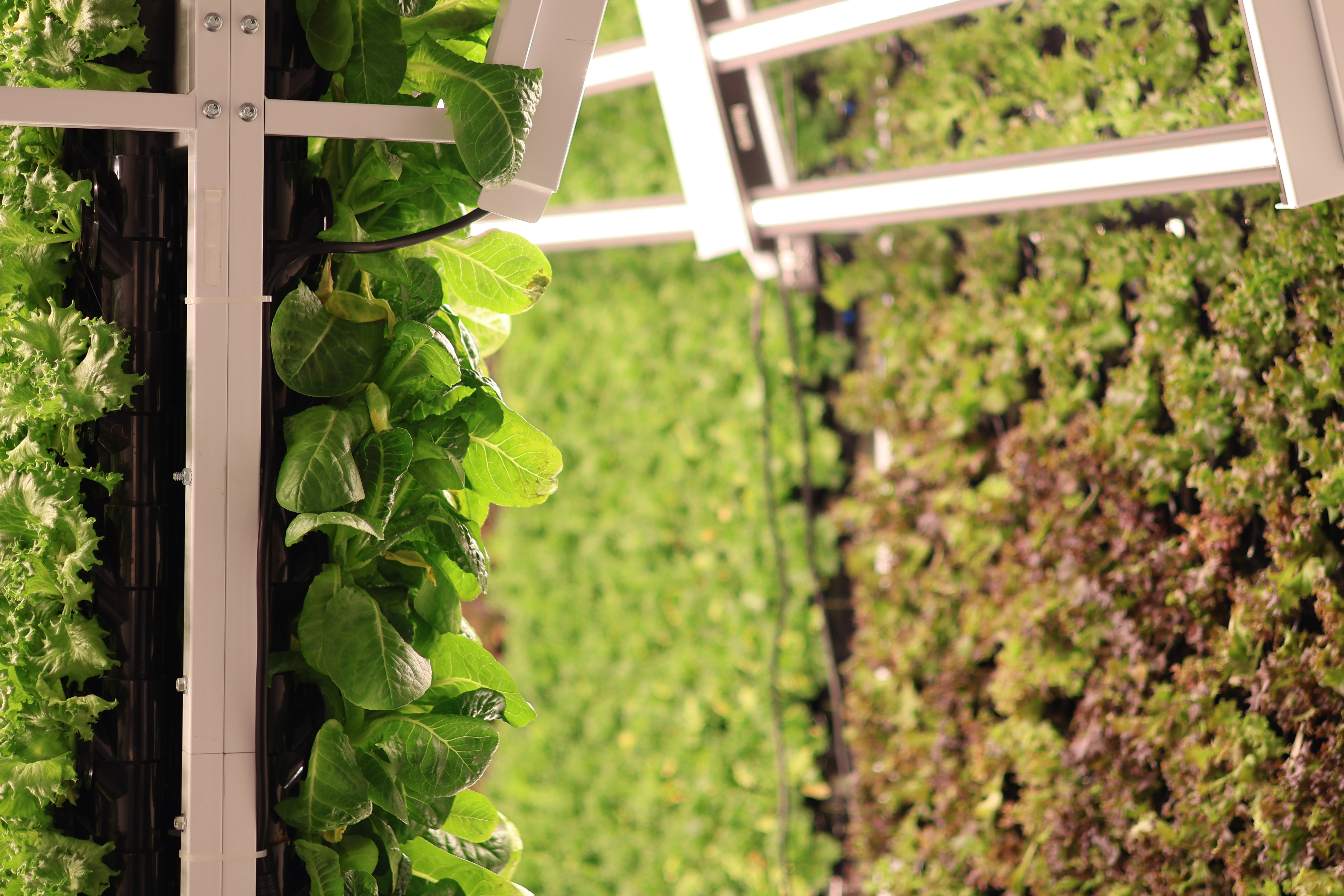
Light source. Dyson rotates crops toward natural sunlight and uses LEDs as a winter backup. In contrast, Just Vertical's commercial systems rely on controlled, adaptive LED lighting as the primary source, removing weather and daylight hours as variables. For schools, universities, or community spaces, this predictability ensures consistent production. A grow room in Ontario can produce the exact same output in January as it does in July, regardless of weekly sunlight variations.
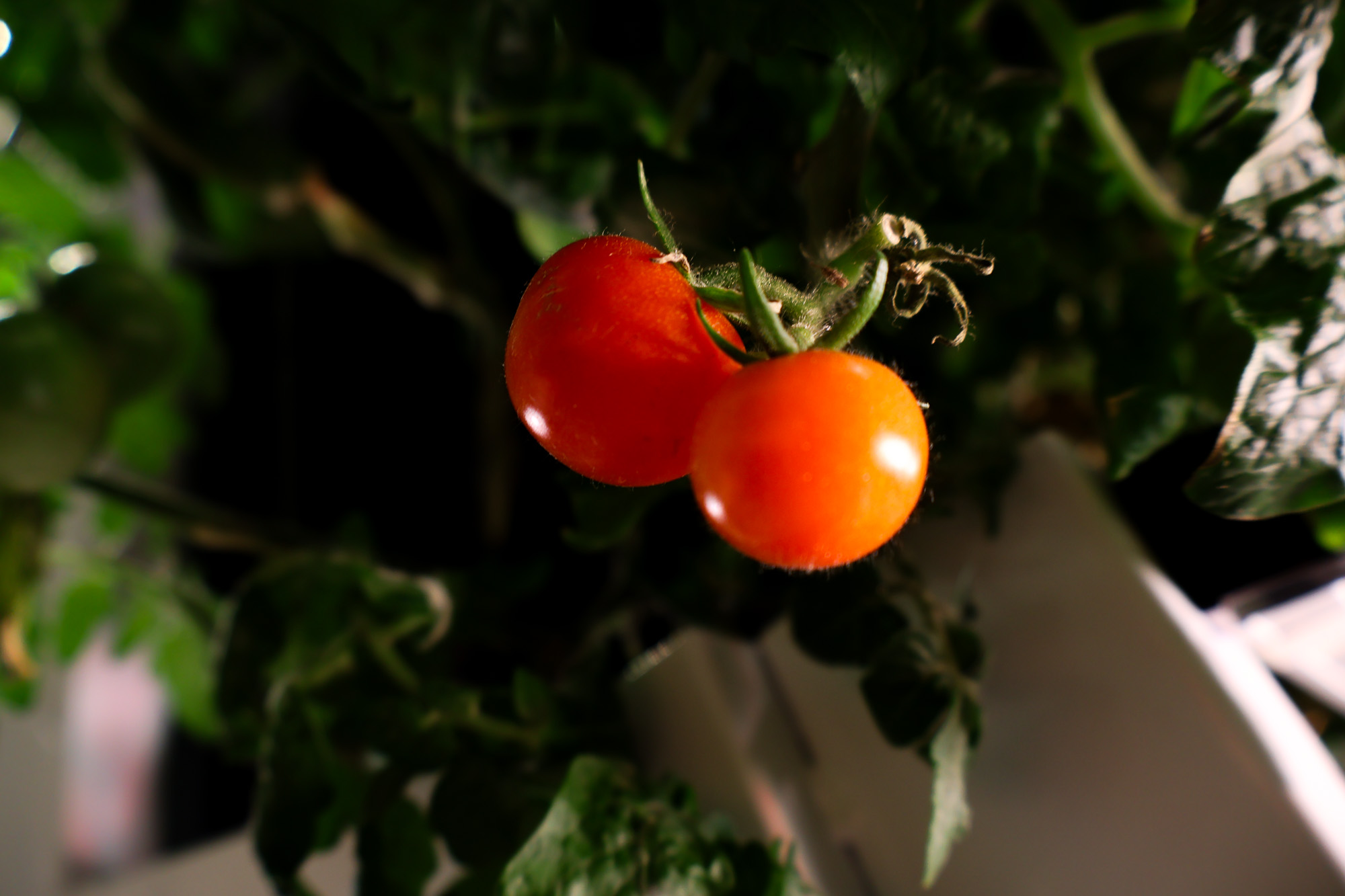
Crop focus. The Carrington facility centers strictly on a single crop, strawberries, to fulfill high-volume wholesale retail contracts. A true indoor LED system is instead engineered to support multiple crops simultaneously, as the microclimate and lighting configurations are not restricted to a single plant's biology. This built-in flexibility allows dining halls or food service programs to easily shift their production to match changing seasonal menus.
Scale and footprint. The Carrington infrastructure spans dozens of acres and integrates an adjacent anaerobic digester. A modular indoor system scales down to fit existing environments, with commercial setups like Just Vertical's modular hydroponic racks starting around 160 to 320 square feet. This compact footprint allows thousands of schools, corporate campuses, and localized community organizations to adopt vertical farming inside facilities they already operate.
Ultimately, this comparison highlights that vertical farming is not a single, rigid technology. It is a flexible design space where the ideal setup depends entirely on the specific problem an organization wants to solve.
Dyson's model provides an effective path for supplying major retailers at a national scale. Conversely, a modular, multi-crop system offers a practical option for institutions that require flexibility and a footprint that integrates seamlessly into existing indoor spaces. For a broader look at how the industry has shifted this year, our 2026 vertical farming analysis breaks down the latest economics and explains how these indoor growing systems balance their operational costs while maximizing their daily harvests.
The future of vertical farming is developing on two distinct fronts simultaneously. Industrial-scale hubs like Carrington stabilize commercial retail supply chains for high-value, weather-sensitive crops using circular energy systems. At the same time, decentralized, modular systems give schools, community hubs, and local institutions the power to grow food independently without needing acres of land or massive infrastructure.
Dyson's success reinforces the validity of smaller systems rather than crowding them out. It demonstrates that controlled environment agriculture, regardless of scale, has become a reliable component of modern food production.
Big, capital-intensive innovation like Dyson's proves vertical farming works at scale, and modular systems prove it also works at a much smaller footprint. Though on different scales, these two facets of vertical farming move forward together in the same industry, and provide a wider set of options for anyone trying to figure out where their own project fits.
It signals that vertical farming has moved past its early hype cycle into a more disciplined, credible industry. Dyson's Carrington glasshouse, expanding from 26 to 42 acres and built around a rotating Hybrid Vertical Growing System, shows a major engineering firm treating controlled environment agriculture as a durable, investable category.
HVGS is Dyson's rotating rig system, standing roughly 5.5 meters tall and holding about 1.2 million strawberry plants. It rotates plants toward natural sunlight inside a glasshouse, delivering 2.5 times the space efficiency of static under-LED stacking and a reported 250% yield boost.
Sunlight costs nothing, while LED lighting is typically one of the largest ongoing expenses in vertical farming. By rotating plants toward the sun and using LEDs only as a supplement, Dyson cuts its energy burden, addressing the cost bottleneck that closed down several earlier vertical farms.
No. Dyson runs a single-crop, industrial-scale glasshouse supplying premium retailers nationally. Just Vertical builds modular, indoor LED systems for schools, universities, and community operators, growing over 200 crop varieties in footprints as small as 160 square feet.
No, it validates the category as a whole. Dyson's investment proves the underlying technology works at scale. Smaller, modular systems like Just Vertical's still serve institutions that need flexibility, crop variety, and a footprint a 42-acre glasshouse could never offer.
Would you rather we reach out to you? Fill out the form to have a member of our team to reach out and discuss your growing goals.


