


Let's Talk
We'd love to hear about your project. Book a time that works for you and we'll take care of the rest.
- Commercial projects
- Education & institutions
- Partnerships & resellers
- General inquiries
We'd love to hear about your project. Book a time that works for you and we'll take care of the rest.

Contents
NASA space agriculture vertical farming research is not just a novelty story about astronauts snacking on lettuce. It is the origin story for an entire industry now taking root in cities around the world. That story starts with one remarkably tough problem. There is no soil on the International Space Station, no open sunlight, and no room to waste a single drop of water.
Solving that problem forced NASA to answer questions that indoor growers everywhere still wrestle with today. How do you deliver water, light, and nutrients with total precision, when nothing about the environment helps you along? NASA figured out how to grow food in a sealed box, using recycled water and programmed light. That engineering breakthrough quietly became the blueprint for controlled environment agriculture on Earth. In other words, the physics that feeds an astronaut on the ISS also feeds cafeterias and classrooms back home.
This piece walks through NASA's Advanced Plant Habitat, the crops NASA breeds for tight spaces, and the genetics research now underway aboard the ISS. From there, we trace the closed loop systems back to a chamber built in 1988. We also look at where this same science is showing up in commercial and educational vertical farms today. By the end, the connection from Mars to your city stops being theoretical.
NASA space agriculture vertical farming technology starts with a machine called the Advanced Plant Habitat, or APH. It is the largest and most sophisticated plant growth chamber ever built for the International Space Station. Unlike earlier, simpler space gardens like the Veggie system, which relies on soft fabric-based plant pillows, the APH is fully enclosed and highly automated. As a result, it needs almost no help from astronauts once it is running.
Picture a high-tech garden with no dirt and no window, and you have pictured the APH. In place of soil, it uses a porous clay substrate paired with controlled-release fertilizers. It also holds exact setpoint control over temperature, humidity, carbon dioxide, and root-zone moisture. On top of that, it delivers precise, automated amounts of water, nutrients, and oxygen straight to plant roots. Above all, it does this without a single ray of natural sunlight involved.
Crews aboard the ISS have carried this work well beyond peppers, moving through hydroponic systems and plant pillows to grow tomatoes and even flowers. Each round of testing edges the program closer to a meaningful milestone: crops explorers could grow reliably on long-duration missions to the Moon and Mars.
A few things make the APH worth studying, if you run or plan to build a commercial indoor farm:
We think this matters for a simple reason. It answers the first question every skeptical facility manager asks: is this proven technology, or just a lab experiment? NASA has been running sealed growth chambers since the 1980s, building a track record rather than chasing a trend. For a quick primer on how this works, this BBC News explainer on growing plants in space covers the same ground from a different angle.
NASA grows compact, high-yield crops for a simple reason. Space aboard the ISS is some of the most expensive real estate in existence, so every cubic inch inside the APH has to produce food. NASA researchers have said plainly that they breed plants that are super nutritious and super flavorful. At the same time, those plants have to stay small enough to thrive inside a growth chamber.
That is why microgreens like mustard, radish, and kale show up again and again in ISS experiments. They are harvested early in their growth cycle, so they take up almost no space. At the same time, they pack in concentrated nutrients and flavor, which helps astronauts fight the menu fatigue that comes with months of pre-packaged meals. Similarly, strawberries earn a spot on the crew's growing list. NASA has actively tested them grown entirely from seed at the Space Station Processing Facility at Kennedy Space Center.
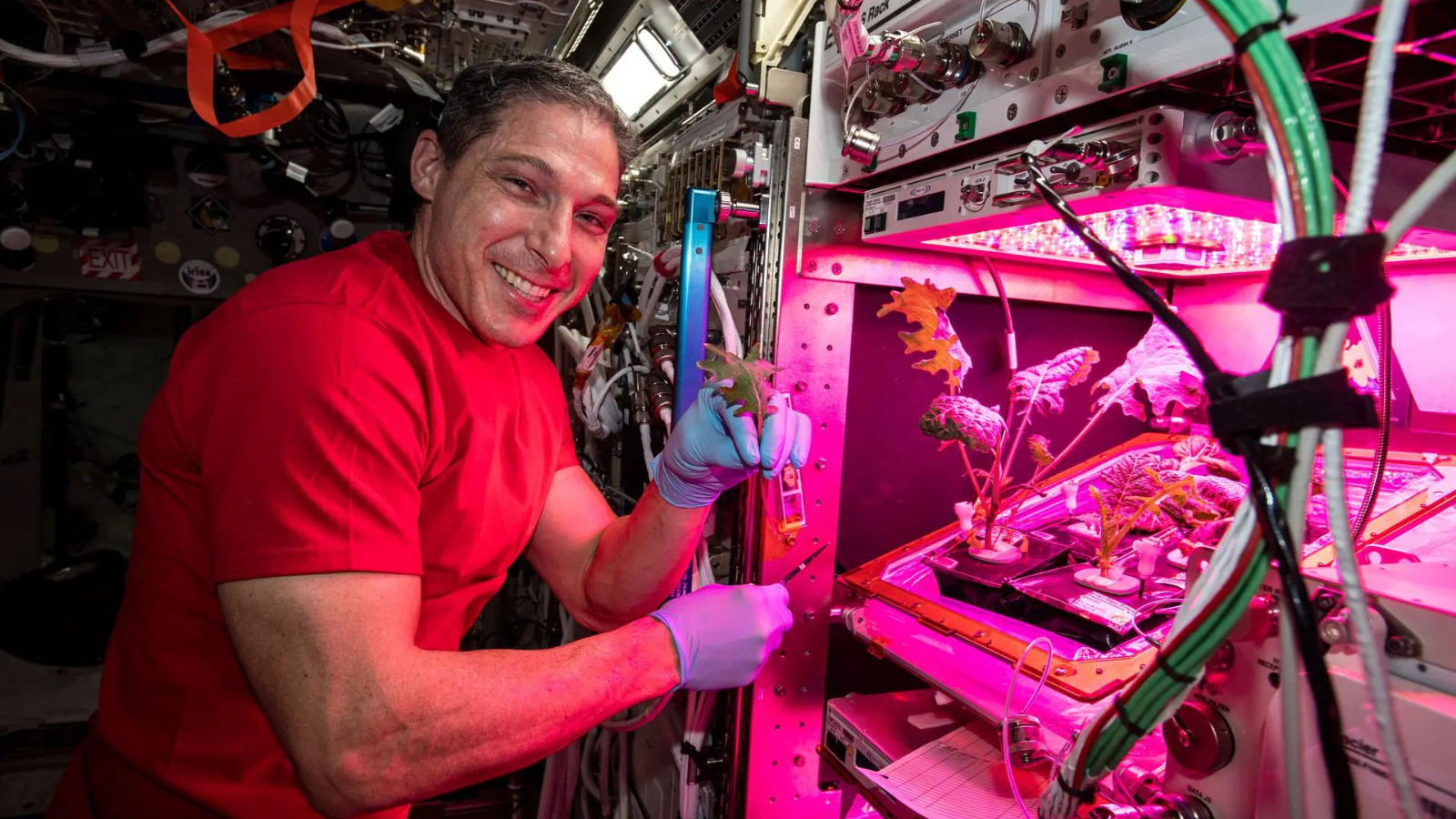
Commercial vertical farms face the identical math, whether the site is a repurposed warehouse or a shipping container in a parking lot. For example, Just Vertical's own systems are engineered to grow more than 200 crop varieties. These range from leafy greens and herbs to microgreens, edible flowers, dwarf tomatoes, and strawberries, chosen because they perform well in a modular, vertical footprint. This is not a coincidence. Instead, it is the same crop science principle NASA proved out first.
A short list of what compact crop selection buys any grower, whether orbiting Earth or running a container farm in a city:
If you want to see how crop selection plays into a full commercial buildout, our technology page breaks down how modular racks get configured for this kind of yield optimization.
Plant Habitat-03 is a NASA experiment built around one bold question. Do stress adaptations a plant experiences in space pass down to its seeds? The study uses Arabidopsis thaliana, a small flowering plant favored by researchers for its fast life cycle. Astronauts aboard the ISS performed a thinning exercise as part of the study. They removed seedlings so the remaining plants had more room to grow.
This is not the only ISS experiment probing how plants change under pressure. The Veggie growth chamber bathes its crops in a magenta glow, tuned to the exact wavelengths plants use for photosynthesis. It once hosted an experiment called Veg-06. There, astronauts grew alfalfa alongside beneficial bacteria to study nitrogen capture. At the same time, they tracked how lignin, the material that helps plants stand upright, behaves differently in microgravity. Once harvested, the plants were frozen and returned to Earth aboard a cargo Dragon for further analysis.
Why does any of this matter if you are not an astronaut? University researchers on the project are studying how these spaceflight-triggered changes move across generations. As a result, that research has direct implications for breeding hardier crops here on Earth.
Think of it like training a muscle memory into a plant's descendants. A strawberry plant might learn to cope with a stressful growing cycle in space. In turn, its offspring may inherit some of that resilience, without a single gene being rewritten. Consequently, this has real potential for growers everywhere who want crops that hold up under variable light, temperature swings, or nutrient stress.
We are watching this research closely, because hardier crop lines mean fewer failed cycles and more predictable yield in commercial deployments. Breeding advances that start in orbit could eventually improve reliability in vertical farms on the ground. The same epigenetic principles now under study for spaceflight stress could also help botanists develop crops suited to marginal or climate-stressed land on Earth.
NASA's Biomass Production Chamber, or BPC, ran at Kennedy Space Center from 1988 to 2000. It started life as a retired hypobaric test chamber, before engineers converted it into an upright, stacked hydroponic farm. That conversion arguably makes it the first vertical farm built in the United States. The BPC used closed loop methods on purpose, designed to mirror the resource constraints of a future Mars mission.
That constraint turned out to be the whole point. After all, a Mars mission cannot carry unlimited water. So, the BPC pioneered closed loop water recycling, decades before sustainability became a marketing buzzword. Inside the chamber, water transpired by the plants was condensed out of the air. Subsequently, it passed through ion exchange columns to strip out impurities, before recycling straight back into the nutrient reservoirs.
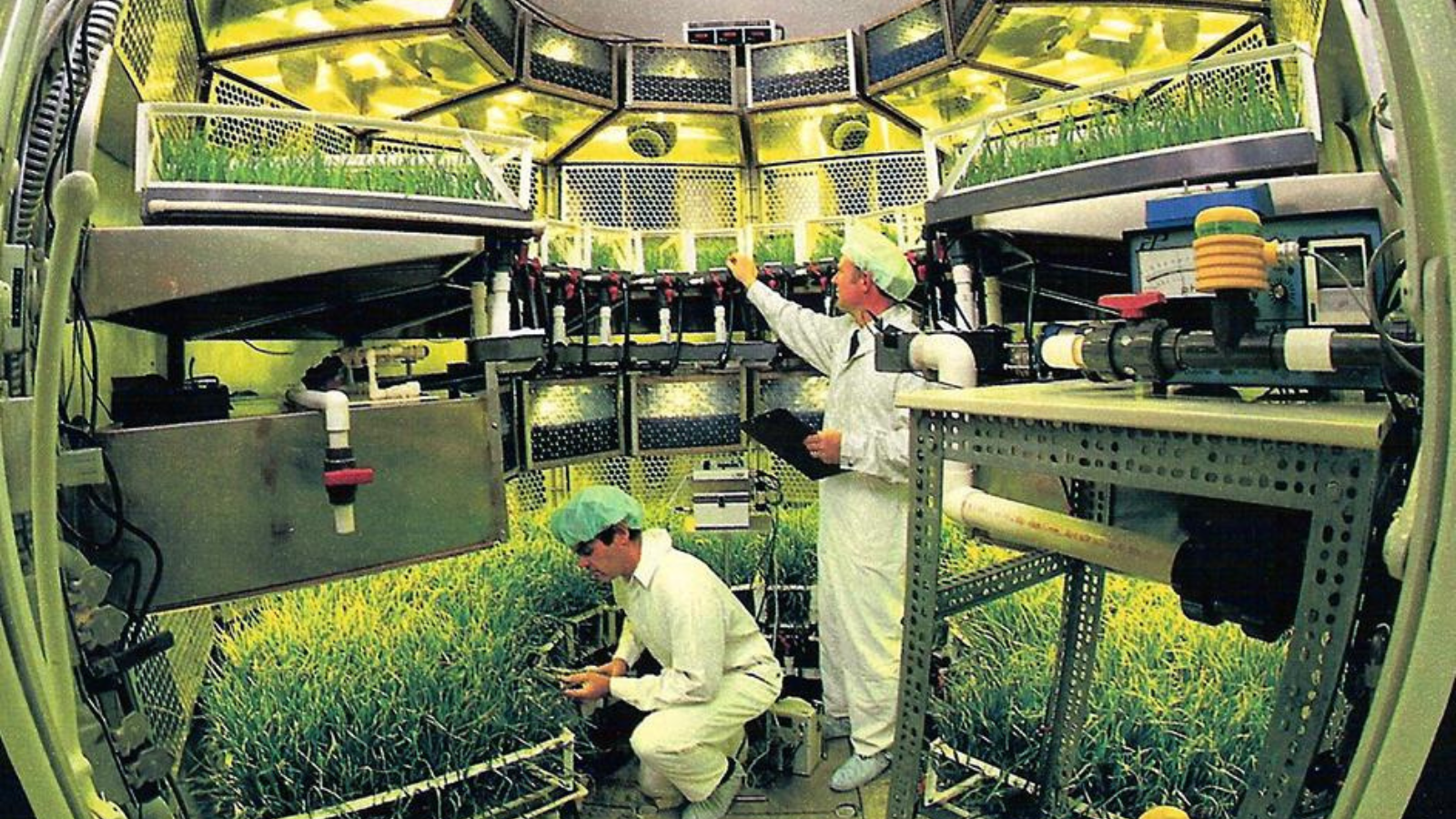
That same research thread directly optimized how plant growth works inside a fully enclosed chamber, the same challenge commercial indoor farms solve at scale today. Just Vertical's own hydroponic closed loop systems, to name one working example, use up to 95 percent less water than conventional field farming. That places them as a direct Earth-side descendant of the BPC's recycled-water model. It is a lineage that traces back to a converted test chamber at Kennedy Space Center in 1988.
Closed loop water and adaptive lighting systems work on Earth today much like they did aboard the ISS. Water gets captured, filtered, and recirculated instead of drained. Light gets tuned to the specific wavelength a crop needs, instead of blasting a fixed spectrum at everything in the room. That is not unlike the way Veggie's magenta glow is tuned to exactly what its plants can use.
This is not science fiction anymore. It is standard equipment across the controlled environment agriculture industry. Similarly, companies large and small, including well-known players like Plenty Unlimited Inc., now use the same closed loop frameworks NASA developed decades earlier. Just Vertical's commercial systems, as one case in point, couple high-efficiency adaptive LED lighting with smart climate automation. As a result, this combination cuts energy footprints by 15 to 30 percent compared to traditional fixed-spectrum indoor setups. That range depends on crop mix and facility size.
Here is what a closed loop system typically includes in a commercial NASA space agriculture vertical farming deployment:
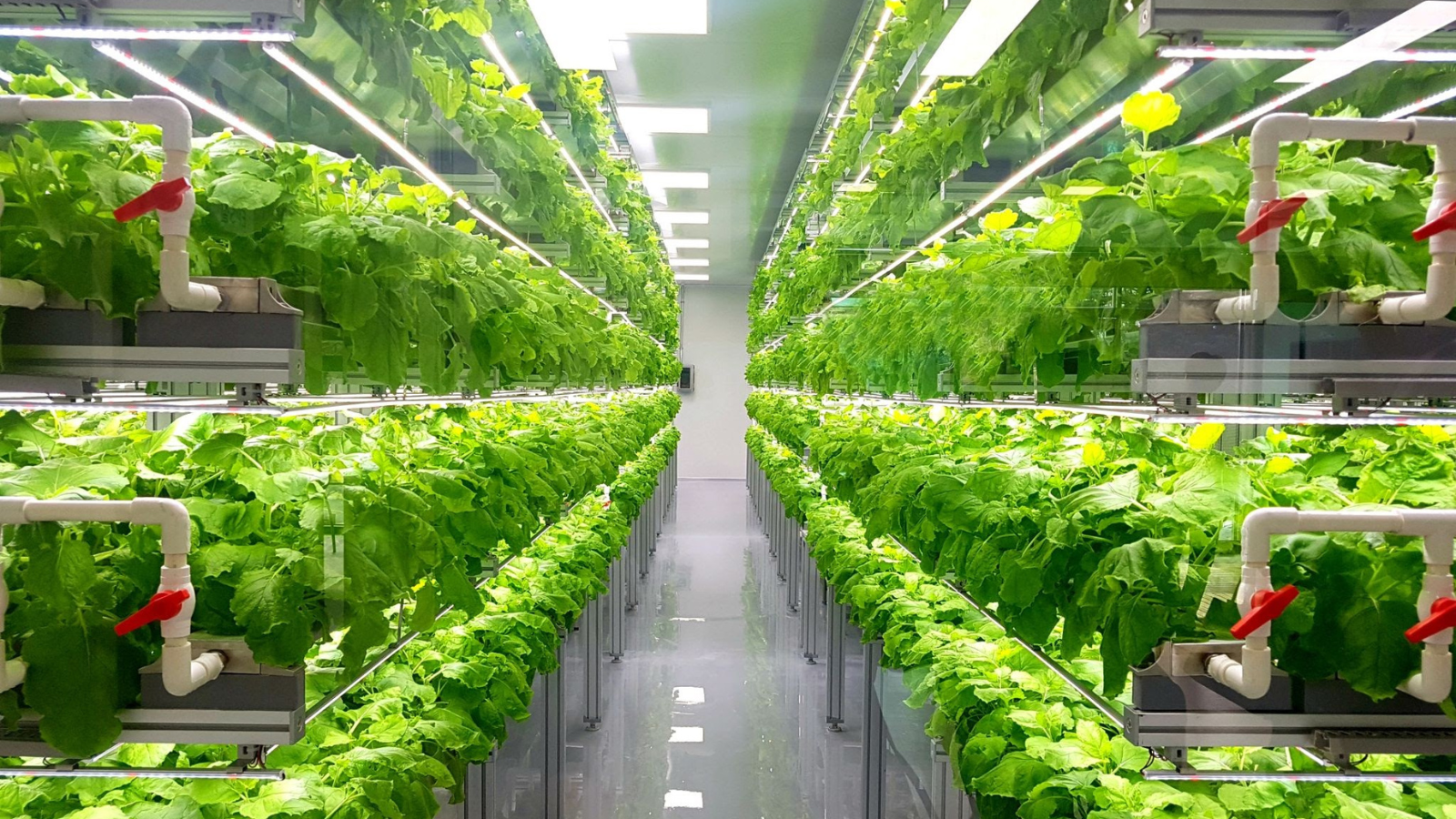
Deployments built on this model can scale to produce anywhere from 5,000 to 12,000 kilograms of fresh produce per year, depending on the modular configuration and crop mix chosen. That range exists because the same modular thinking behind the APH lets an operator size a system to actual space and demand. Therefore, nobody has to build one size fits all. Industry reporting suggests urban vertical farms can produce up to 390 times more food per square foot than traditional outdoor farming.
A real NASA-inspired vertical farm looks like Seneca College's Newnham Campus, where a two-story retrofitted shipping container runs Just Vertical technology from top to bottom. Students there do not just harvest greens for the cafeteria. They run their own applied research, testing light spectra and nutrient recipes to optimize what we call crop recipes.
That is not a coincidence of language. In fact, it is the same process NASA runs inside the APH: control the variables, measure the outcome, refine the recipe, and repeat. The difference is location. Seneca's farm sits on a college campus in Ontario, not in orbit above the planet.
We consider Seneca a proof point for one clear reason. It puts research in the hands of students, not just engineers. Therefore, the same curiosity that drives a NASA botany experiment now drives an undergraduate research project. You can read the full Seneca College case study to see how their team structures its own light and nutrient testing.
This case study matters for one more reason. It shows that closed loop, NASA-descended technology is not locked inside a research lab. Instead, it runs in a building that students walk past every day between classes.
Vertical farming technology is proven, and the NASA record is the clearest evidence available. NASA has operated sealed, soil-free growth chambers since the Biomass Production Chamber launched in 1988. Since then, it has refined that same closed loop approach through the Advanced Plant Habitat on the ISS. Altogether, that adds up to nearly four decades of continuous, documented operation.
We understand why a facility manager or procurement team asks this question before signing off on a build. After all, a shipping container farm is a real capital commitment. However, the underlying science here did not start with a startup pitch deck. Instead, it started with a federal space agency solving a life support problem. Since then, it has been tested in orbit, under conditions far harsher than any warehouse or campus basement.
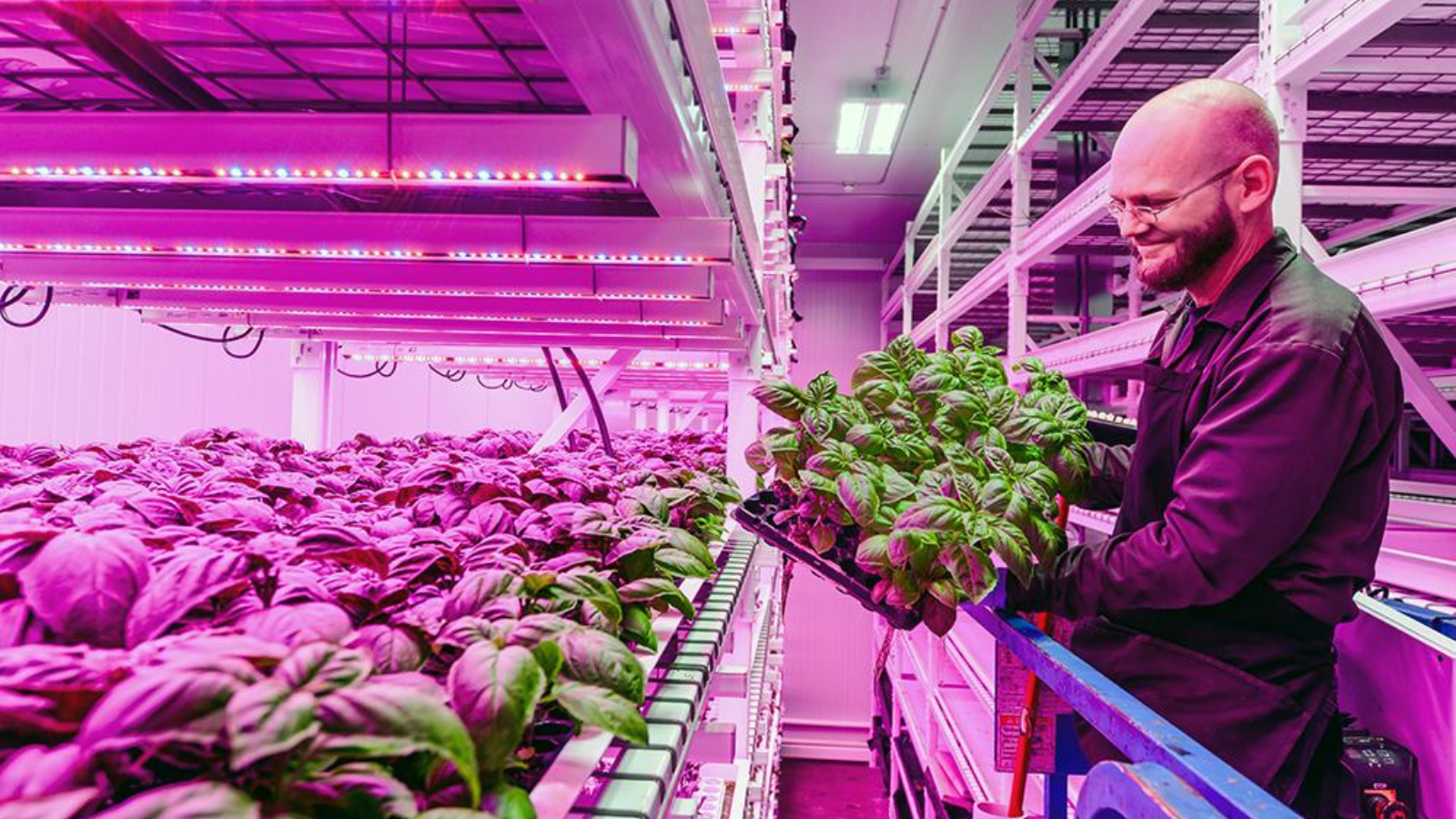
A short comparison of where the proof points sit:
In short, this is not an unproven trend. Instead, it is a technology with a research pedigree that includes one of the most demanding testing environments in existence: outer space.
The future of space agriculture and Earth farming points toward one destination. That destination is feeding more people with less land and less water. A widely cited United Nations projection puts the added population needing food by 2050 at roughly 2.3 billion people, mostly in urban centers. That is the same feeding challenge NASA studied for astronauts. Similarly, it is now playing out in commercial and urban indoor farming at companies across the industry.
We do not think that comparison is a stretch. In fact, an astronaut on a Mars mission and a resident in a growing city share a version of the same constraint. Both face limited land and limited water, and likewise, both need food security regardless of season or supply chain disruption.
That is the takeaway worth carrying forward. Space agriculture is not a novelty. Instead, it is the origin story for the closed loop water and lighting systems now running commercial vertical farms in real cities. What NASA proved out for Mars is already at work here on Earth.
NASA space agriculture refers to the plant growth research NASA conducts aboard the ISS, especially through the Advanced Plant Habitat. It relates to vertical farming because both rely on soil-free, closed loop systems. Those systems deliver water, nutrients, and light without natural sunlight or open ground.
The Advanced Plant Habitat is NASA's most sophisticated plant growth chamber built for the ISS. It automates water, nutrient, and oxygen delivery to plant roots. Researchers use it to grow and study crops like chile peppers, strawberries, and microgreens in a fully enclosed environment.
NASA studies epigenetics through experiments like Plant Habitat-03, which uses Arabidopsis thaliana. The goal is to understand whether stress adaptations plants develop in space pass to future generations. This research could help breed hardier, more resilient crop varieties for both space missions and Earth-based agriculture.
Closed loop hydroponic systems, including those Just Vertical operates commercially, use up to 95 percent less water than conventional field farming. This works by capturing and recirculating irrigation water, instead of letting it drain away or evaporate.
Vertical farming technology is backed by decades of documented research. That research started with NASA's Biomass Production Chamber in 1988 and continues through the Advanced Plant Habitat today. Real-world sites like Seneca College's Newnham Campus farm show the same science succeeding outside a lab.
Seneca College's Newnham Campus operates a two-story retrofitted shipping container farm using Just Vertical technology. Students there actively test light spectra and nutrient recipes. It is one of the clearest working examples connecting NASA's research approach to a commercial, campus-based deployment.
Would you rather we reach out to you? Fill out the form to have a member of our team to reach out and discuss your growing goals.


