


Let's Talk
We'd love to hear about your project. Book a time that works for you and we'll take care of the rest.
- Commercial projects
- Education & institutions
- Partnerships & resellers
- General inquiries
We'd love to hear about your project. Book a time that works for you and we'll take care of the rest.

Contents
Vertical farming fertilizer costs barely moved this year, even while global urea prices swung wildly. Prices climbed from lows near $400 a ton to highs above $900, then fell back again. That swing hit traditional field farmers hard, since they buy fertilizer by the ton. As a result, their crop budget rises and falls right along with it.
We did not feel that same shock, and the reason comes down to how we deliver nutrients. Closed-loop hydroponic systems recirculate a precise nutrient solution instead of broadcasting fertilizer across open soil. As a result, a spike in the commodity market never turns into a spike in our operating budget. That gap comes down to structure rather than luck, and the data on fertilizer waste in the field explains exactly why.
For commercial buyers weighing a container farm against a traditional field operation, that predictability matters as much as yield. It is what lets you build a five year budget without guessing at commodity swings. Traditional operators, meanwhile, end up rebuilding that same budget every time a shipping lane closes or a gas exporter changes policy. That turns fertilizer into a structural weakness in how field agriculture prices its single largest recurring input.
Global urea prices spiked to between $900 and $1,050 a ton during recent supply shocks, then then corrected back down to roughly $400 a ton once conditions eased. The whole swing traces back to one cause: natural gas disruptions and shipping risk tied to the Strait of Hormuz pushed prices up. Once the strait reopened and export supply returned to normal trade routes, prices fell just as fast. The Western Producer tracked that full arc, from the highs through the correction. The outlet reported that Argus Media analyst Owen Gooch expects prices to stay closer to that lower range for now.
Here is what that swing looked like in practice:
Why Urea Prices Just Spiked $120
For a field operation, that kind of swing forces a full budget rewrite, and it is not a one-time event. Urea prices have swung this hard before, and they will likely swing again the next time gas markets tighten. For us, the swing barely registered. The next section explains why urea price volatility hits soil farming so much harder than it hits vertical operations.
No farmer chooses to overspend on purpose, but the physics of open soil application leaves little choice. Fertilizer applied to a field has to travel through soil, weather, and irrigation before it reaches a root. Therefore, some loss is built into the method itself, long before price ever enters the picture.
Field farmers feel every fertilizer price swing because so much of what they apply never reaches the crop. According to FAO's land and water nutrient management research, up to 70% of the nitrogen applied as urea is lost. That loss happens through ammonia volatilization, nitrate leaching into groundwater, or denitrification, where soil bacteria convert nitrogen into gases like nitrous oxide. In other words, a field farmer is not just buying fertilizer for the plant. Instead, they are also buying it for the runoff, the leaching, and the gas that escapes before a root can absorb it.
Better application timing and soil testing can reduce that loss somewhat. However, even the best conventional practices still leave a meaningful share of applied nitrogen unaccounted for. For example, picture a bucket with a hole in the bottom. You keep pouring, but a good share of what you pour never stays where you need it. That is the leaky bucket problem, and it means:

Urea price volatility is built into the market because urea comes from natural gas, and natural gas prices move with global politics. Synthetic urea is produced through the Haber-Bosch process. This method combines nitrogen pulled from the air with hydrogen derived from natural gas, under high heat and pressure. Therefore, whenever a pipeline is disrupted or a shipping lane closes, that shock travels straight through to fertilizer prices. That is exactly why the 2026 urea swing tracked so closely with shipping and energy news, rather than anything happening on farms themselves.
That pattern is likely to repeat every time a similar shock hits energy markets, regardless of the season or the crop being grown. For instance, the reopening of a single shipping strait was enough to send prices down by hundreds of dollars a ton within weeks. That tells you urea pricing has very little to do with crop demand. It has almost everything to do with energy markets.
For a field farmer, that means fertilizer cost is essentially a bet on global energy prices. It is a bet they are making whether they intend to or not, since gas markets respond to decisions made far outside any single farm. Meanwhile, for us, it is a market we do not need to time. Our nutrient dosing does not scale with commodity swings the way soil application does.
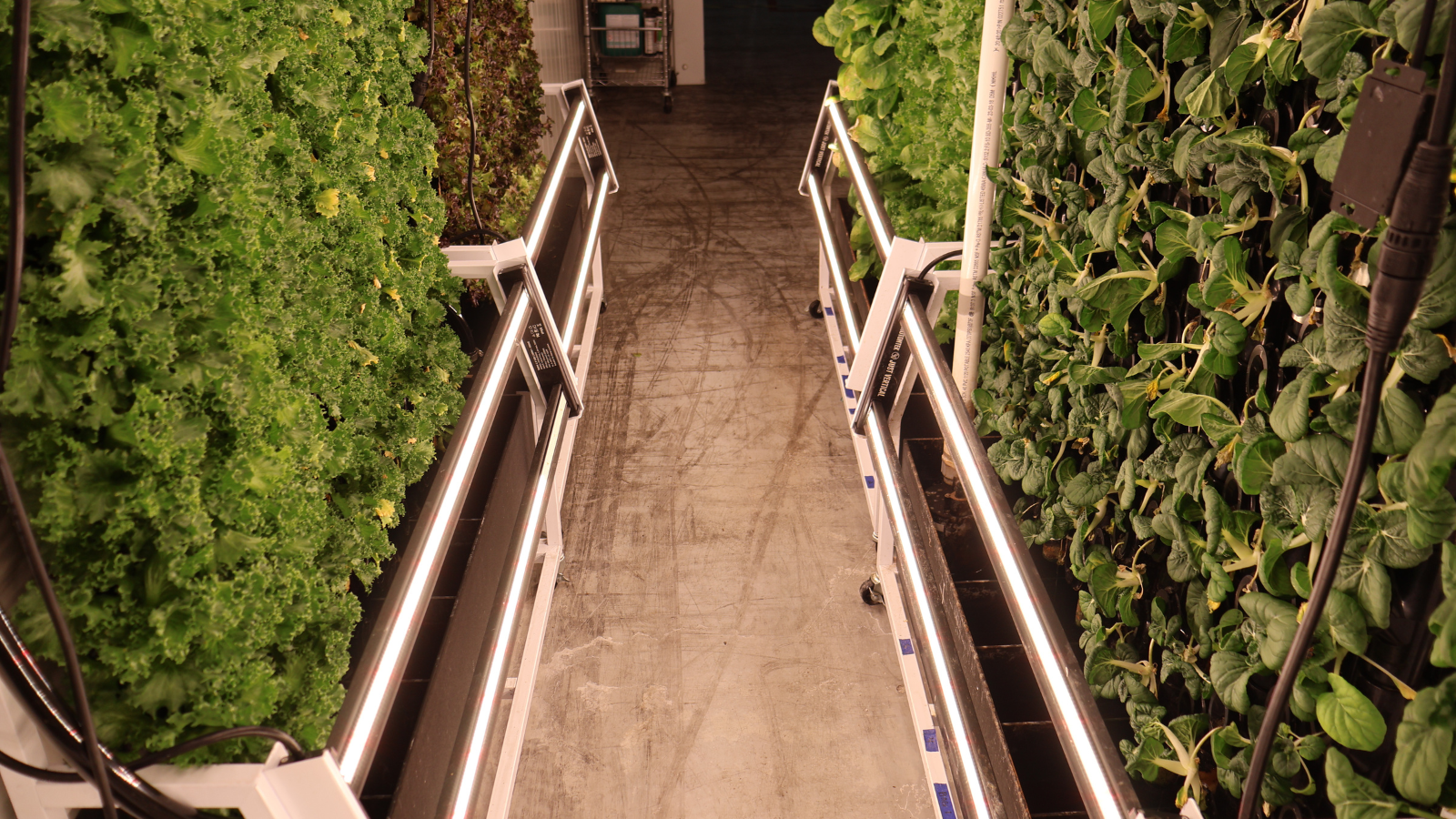
Closed-loop hydroponic nutrient dosing works by recirculating a nutrient solution instead of applying fertilizer once and letting the excess wash away. Sensors track electrical conductivity and pH in real time. The system then adds only the specific nutrients the plant needs at that moment. As a result, nothing gets poured onto open ground, and nothing leaches into groundwater. Meanwhile, every plant in the system draws from the same monitored reservoir. That means the amount of nutrient applied is tied to actual demand rather than guesswork.
Here is what that process typically includes:
More detail on how this dosing infrastructure is engineered lives on our indoor farming technology page, for readers who want the full technical picture.
Vertical farming fertilizer costs sit at a small fraction of what field agriculture spends as a share of total operating expenses. According to AgFunder's breakdown of second-generation vertical farming economics, fertilizer can account for 20% to 40% of total operating expenses for conventional field farmers. That figure depends on crop type and fertilizer price swings. For vertical farms, on the other hand, nutrient solutions run under 2% to 5% of total OPEX instead. The same reporting notes that vertical farm operating costs are dominated by electricity and lighting, at roughly 30%, and labor, at another 30%. Fertilizer, in other words, sits far down the list of things a commercial operator needs to worry about.
That gap comes down to precision. A field farmer's fertilizer bill scales with acreage and with waste, including every acre they cannot precisely monitor in real time. A vertical farm's nutrient bill, by contrast, scales with the actual biomass being grown, because the dosing system only adds what the plant will use.
What the third party data above does confirm is that the structural gap between soil and hydroponic nutrient spending is large. It is large enough to matter for anyone building a long-term operating budget around vertical farming operating costs. Moreover, it is large enough that even a conservative estimate favors the closed-loop model by a wide margin.
Input-cost stability extends well beyond fertilizer for controlled environment agriculture, and water is the clearest example. Just Vertical's closed-loop hydroponic setup uses up to 95% less water than conventional field farming. Similarly, that insulates our operations from water rate increases, the same way our nutrient dosing insulates us from urea price volatility.
Energy tells a similar story. Our modern commercial systems couple high-efficiency adaptive LED lighting with smart climate control automation. That combination reduces energy footprints by 15% to 30% compared with traditional fixed-spectrum indoor setups. That automation means we are not reacting to utility rate spikes after the fact. As a result, we are not just avoiding one commodity risk. We are engineering out variable input costs across water, energy, and nutrients at the same time.
Consider the pattern here:
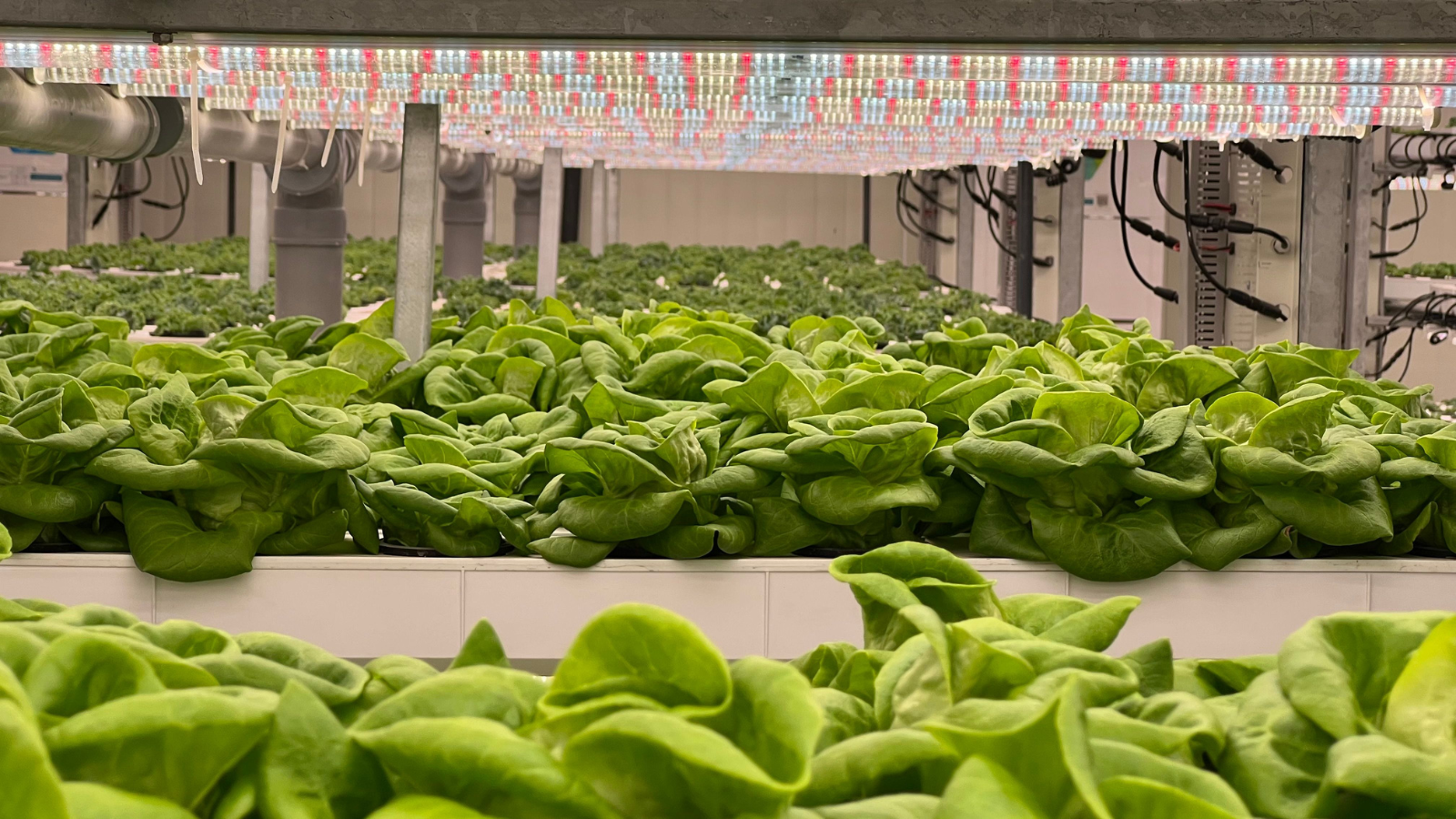
This means commercial buyers and investors can build operating budgets without pricing in commodity shocks the way field agriculture must. Fertilizer volatility is a real, recurring cost risk in traditional farming. Closed-loop hydroponic systems are structurally designed around that risk, rather than simply lucky to avoid it. That distinction matters, because a structural advantage holds up year after year, while a lucky break does not.
If you are underwriting a five year proforma for a commercial farm, think about the variables involved. A cost that can swing 50% or more in a single year is worth eliminating rather than managing. Our closed-loop approach to nutrients, alongside similar approaches to water and energy, is exactly how we do that.
We would encourage anyone comparing indoor farming to traditional agriculture to look past day one setup costs. Instead, focus on which model gives you a predictable operating budget five years out. Setup cost still matters, and no one should ignore it. However, a farm that costs less to build while carrying a volatile fertilizer bill can end up costing more over a full operating cycle. In other words, the number on day one is rarely the number that determines your actual return. For a deeper look at the full cost picture, visit our Economics and ROI pillar page. There, we break down vertical farming fertilizer costs alongside total operating expenses in more depth.
Urea will keep swinging with the gas and shipping markets that produce it, and that is not a prediction anyone can change. What this year's swing really shows is that input-cost risk is not evenly distributed across farming methods. Field agriculture absorbs that risk directly, because it depends on a supply chain it cannot control. Controlled environment methods absorb far less of that risk. That is not because they got lucky. It is because precision dosing was built to use only what a plant actually needs.
That difference matters well beyond fertilizer. As more of the food system moves toward automation and closed systems, planning for input volatility will matter more. The operations that plan for it ahead of time will be the ones with budgets that hold up, rather than the ones reacting after the fact. Whether you are running a farm, financing one, or simply curious why your grocery bill moves, the lesson is the same. Systems designed around precision are systems designed around stability, and in a market this unpredictable, that stability is worth paying attention to.
Not the way it affects field farming. Vertical farms using closed-loop hydroponic dosing apply nutrients directly and precisely. As a result, a swing in commodity urea prices does not translate into a comparable swing in operating expenses. Fertilizer sits under 2% to 5% of OPEX for vertical farms, versus 20% to 40% for conventional field operations.
Urea prices spiked to between $900 and $1,050 a ton during supply shocks tied to natural gas and shipping disruptions. That figure comes from The Western Producer. Prices then fell back to roughly $400 a ton after the Strait of Hormuz reopened in June 2026. Since urea comes from natural gas through the Haber-Bosch process, energy market shocks travel directly into fertilizer prices.
Research from the FAO's nutrient management program shows up to 70% of nitrogen applied as urea is lost. That loss happens through ammonia volatilization, nitrate leaching, or denitrification before it ever reaches the crop. It is part of why field farmers must buy far more fertilizer than the crop actually needs.
Closed-loop dosing recirculates a nutrient solution while sensors track EC and pH in real time, adding only what the plant needs at that moment. Consequently, because the solution gets reused rather than drained, very little nutrient input is lost, unlike open field application.
Yes, for inputs like fertilizer, water, and energy. Just Vertical's systems use up to 95% less water and 15% to 30% less energy than comparable conventional setups. Combined with a much smaller fertilizer share of OPEX, that gives commercial operators a more predictable long-term budget, regardless of what commodity markets do.
Would you rather we reach out to you? Fill out the form to have a member of our team to reach out and discuss your growing goals.


